

UPDATES
25/08/2026
Installing sensors to improve energy sharing in Alpe Cimbra
To support the digital solutions developed within CELINE, the Green Land Renewable Energy Community in the Italian Demo is deploying 100 Chain2Gate sensors to collect near real-time energy consumption and production data. By complementing the existing smart metering infrastructure, the sensors provide detailed information needed to monitor energy flows, engage community members through personalized services and gamification, and optimize virtual energy sharing. The collected data are integrated into the first prototype of the CELINE Webapp, enabling advanced monitoring, behavioral recommendations and innovative energy management services that help maximise both the environmental and economic benefits of Renewable Energy Communities.
One of the main objectives of the CELINE project is to empower Renewable Energy Community (REC) managers and members with innovative digital tools that support smarter energy management. By providing actionable insights, personalised recommendations and advanced monitoring capabilities, these tools aim to help communities optimise the matching between local renewable energy production and electricity demand, ultimately maximising the amount of virtually shared energy and the associated public incentives.
This objective is particularly relevant in Italy, where Renewable Energy Communities receive national incentives based on the amount of virtually shared energy, the renewable electricity that is simultaneously generated and consumed by REC members connected to the same primary substation. Maximising these incentives therefore requires not only renewable generation capacity, but also a better alignment between energy production and consumption. To achieve this, REC managers and members need timely information that allows them to monitor energy flows, understand consumption patterns, and encourage behavioral changes that increase the amount of shared energy.
The digital solutions developed within CELINE rely on access to high-quality, near real-time energy data. Accurate and timely information on electricity consumption and production is essential to identify opportunities for load shifting, provide meaningful feedback to community members, and support informed decision-making.
The Province of Trento is among the most advanced regions in Italy in terms of electricity metering infrastructure. The local Distribution System Operator (DSO), SET Distribuzione, has already deployed smart electricity meters to more than 90% of its customers, providing a solid foundation for the digitalization of the electricity network.
However, while these smart meters are essential for billing and grid operation, they were not designed to meet the operational needs of Renewable Energy Communities. Data from the DSO are typically available with a delay and often lack the temporal granularity required to monitor energy flows in real time. As a result, REC managers and members have limited visibility of how electricity is produced and consumed within the community, making it difficult to optimize energy sharing and maximise the use of locally generated renewable energy.
To bridge this gap, the CELINE project is deploying around 100 Chain2Gate sensors across the Green Land pilot Renewable Energy Community. Installed alongside the existing smart meters, these sensors provide near real-time measurements of electricity consumption and, where applicable, local renewable generation. By complementing rather than replacing the existing metering infrastructure, they create the digital backbone needed to develop and validate CELINE's digital solutions, enabling smarter energy management and supporting Renewable Energy Communities in maximising both virtually shared energy and the associated national incentives.
Sensors’ installation and data integration
The installed sensors are Chain2Gate devices, which are plugged into a standard household power socket. These sensors capture the energy production and consumption signal that the smart meter emits every 15 minutes, making it possible to monitor photovoltaic production and electricity consumption for each user in near real-time. The data collected by the MAC sensors is then transmitted to the MAPS system and made available to the energy community's operators through the Rose portal, a management platform dedicated to energy communities.
Sensor installation began during Autumn 2025, when Green Land purchased the first 20 Chain2Gate devices. This first batch served as a pilot to test how the system worked and were installed mainly at public administration sites in Folgaria, Lavarone and Luserna, as well as at a number of Green Land members who were particularly interested in keeping a close eye on their own consumption and photovoltaic output. With this first group of sensors, it was possible to gather very useful insights, both for the energy community as a whole and for individual members.
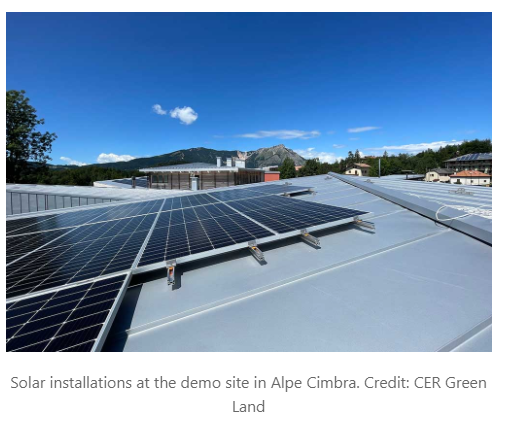
A second example involves a Green Land member who had just installed a 6-kW residential system. By observing this user's consumption and photovoltaic production patterns recorded by the sensors, it emerged that the panels were being used very inefficiently: the system had no storage battery, and the user was drawing energy from the grid whenever the panels were not producing, effectively under-using the photovoltaic output. The recorded energy data have been analysed and structured in order to flag this issue to the member, who then worked to shift its consumption patterns, as much as possible, to the time slots with higher photovoltaic production. This allowed the REC to offer a concrete and practical service as well as energy training, made possible only through sensor-based monitoring.
In April 2026, another 80 sensors arrived, bringing the total to 100 devices, enough to cover a substantial share of Green Land's energy community members. Throughout April and May 2026, installation continued, expanding to other private members as well as small and medium-sized local businesses of various kinds: hotels, restaurants, food-processing companies, and food retail shops. This diversification of user types is particularly important both for the energy community and for the CELINE project: installing sensors across different types of users provides a broader picture of the energy consumed and produced within the community, enabling more precise and interesting analysis than wouldn't be possible using only residential data, which can be fairly uniform and repetitive. Installing sensors at larger, non-residential sites proved more complex: when an electrical system exceeds 6 kW of power, it is typically three-phase, with phases R, S and T running on separate cables. Since the sensor needs to be connected to a socket carrying the T phase in order to work correctly, identifying the right socket required the help of an electrician, especially when installing sensors in food shops, where in some cases a new socket had to be installed near the electric meter specifically for this purpose.
One of the first systems monitored was an 80-kW plant owned by the Municipality of Lavarone which was also the first plant to join the energy community and the one through which the REC received GSE (Gestore dei Servizi Energetici - Italian Energy System Operator) incentives linked to virtual self-consumption within the same primary substation configuration. Among the first insights gained from the sensor installation was the discovery that, following a storm, the plant had shut down and stopped producing energy, resulting in an economic loss for both the Municipality of Lavarone and the energy community.
Data flow for the first CELINE Webapp prototype
During the same period, Spindox developed a communication service to receive real-time data from the sensors and use it to build the first prototype of the CELINE Webapp, which will be included in the CELINE Toolbox. Testing is currently underway with a group of users to evaluate the features of the webapp as it is being developed. By combining real-time sensor data with historical data from the MySET portal, which holds information on grid withdrawal and export, the project aims to develop a webapp that offers users several innovative features: monitoring of photovoltaic production and grid withdrawal, weather forecasts, an overview of the energy community's overall performance, and its environmental impact, expressed in kilograms of CO2 saved and the equivalent number of trees that would need to be planted to achieve the same benefit.
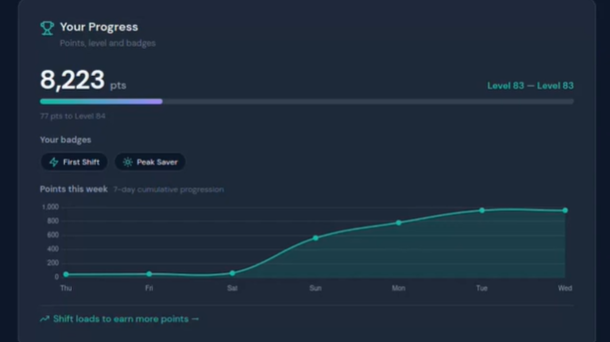
The most innovative feature is the gamification approach taken by the webapp, centered on a points-based system. Through the app, users can take part in load-shifting opportunities, moving their consumption to the time slots when the energy community records higher production. Responding to these “challenges” makes them earn points, which Green Land REC will recognize by awarding vouchers to its most virtuous members. This gamified mechanism can be very effective in engaging members more actively and making them more involved in the life of the REC.
Shifting consumption toward the community's peak production hours increases virtual self-consumption and, as a result, the incentives that GSE rewards to energy communities. The benefit is not limited to the REC: the energy community redistributes part of its revenue to its members, also in proportion to their electricity self-consumption.
At the beginning of August 2026, roughly half of the 100 purchased sensors have been installed, a number that provides a solid initial sample both for understanding the energy community's performance and for testing how CELINE Webapp works. The goal is to gradually extend testing to a larger number of users, in order to gather broader and more varied feedback. Once all the purchased sensors have been installed, it will be possible to achieve much wider monitoring of the energy community and to increase the incentives redistributed to members and to the local area. The CELINE Webapp will also help raise members' awareness around smart and more conscious energy use.
Looking ahead, if a large share of Green Land's members were to make active, day-to-day use of the app, adjusting their household routines to align with the community's overall output rather than just their own system, the potential gains could scale considerably. Coordinated and informed behaviors of this kind would strengthen the community's shared self-consumption, translating into a stronger economic return to redistribute among members, while also generating tangible energy savings and more energy literacy across the whole territory. In such a scenario, both Green Land as a whole and its individual members stand to gain, turning the app from a simple monitoring tool into a genuine driver of collective energy management.
TAGS: